The Money··6 min read
Permits are at a ten-year low and prices are still climbing. That is a supply story, not a demand story.
Builders pulled 4,776 new-home permits in the first seven months of 2026, down 25%. The median new-home close price went up anyway. Both things are true, and together they say something specific about what is actually broken here.
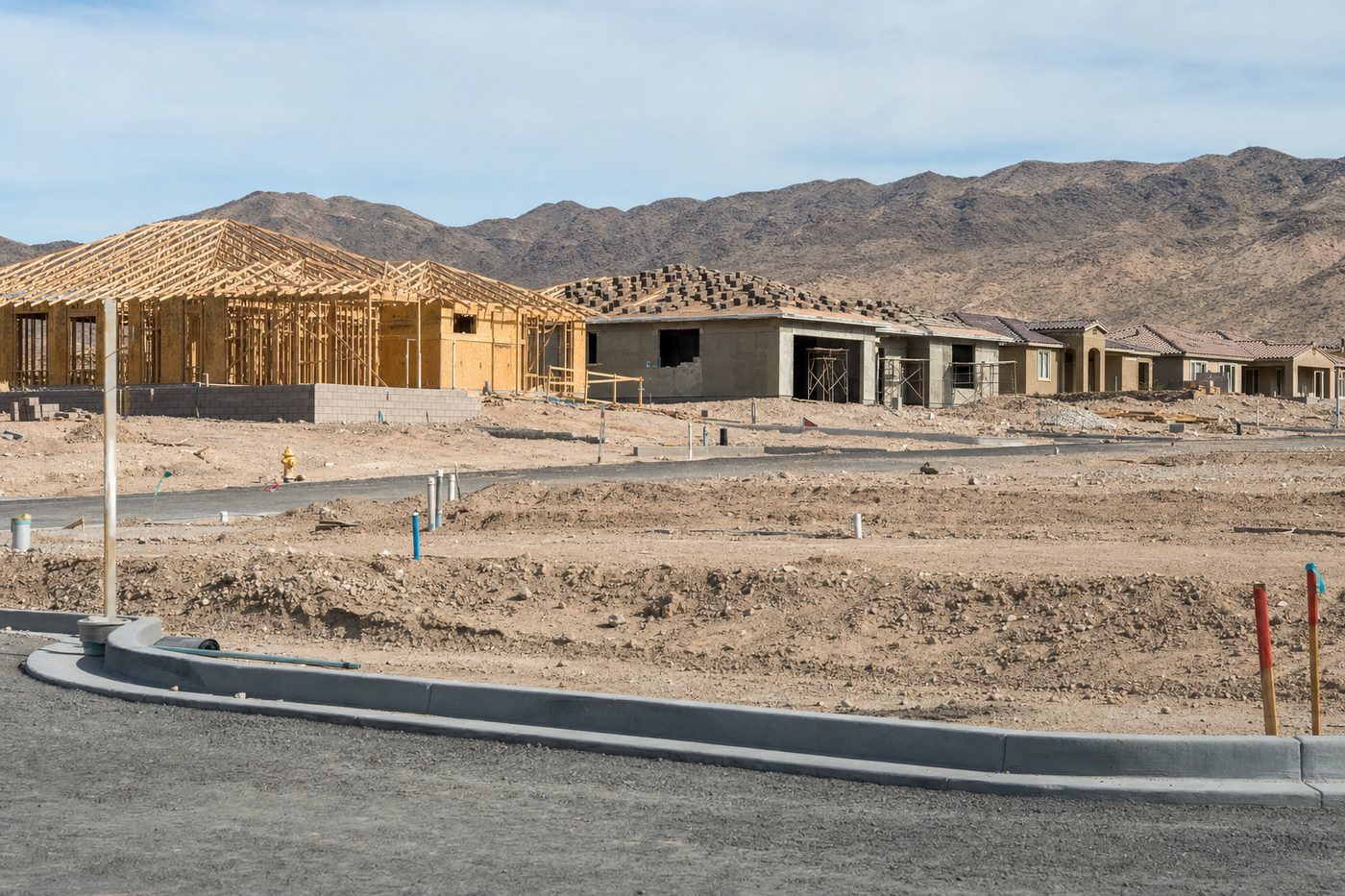
There is a version of a housing slowdown where prices fall, inventory piles up, and builders stop building because nobody is buying. Las Vegas is not having that slowdown. It is having a different one, and the difference matters if you are trying to decide whether to build, buy, or wait.
Here are the two numbers that define the market right now. New-home permits in the valley totaled 4,776 through July, down 25% year over year, and July alone was 620 permits, down 23% (Home Builders Research data via the Review-Journal). Over the same stretch, the median closing price on a new home was $535,114 — up 3% from a year earlier (Review-Journal).
Falling production. Rising price. That combination does not describe buyers walking away.
What a demand collapse would look like instead
If demand were the problem, you would expect the price line to break first and hardest. It has not. On the resale side the median single-family price in July was $480,000, down about 1% year over year and off 2% from the record $490,000 set in May and June (Las Vegas Realtors data via Realtor.com). That is a market flattening at a high level, not one giving back ground.
There is genuine softness in the resale numbers, and it deserves to be said plainly rather than buried. Months of supply moved to roughly 4.0, up from 3.6 the prior month and 3.0 a year earlier. There were 7,442 single-family listings sitting without an offer, up 4.1%. And about 43% of listings had taken a price cut, with a median reduction of $18,900, or 3.7% (Realtor.com). Sellers are negotiating. Mortgage rates around 6.7% are doing what they do (Realtor.com).
But a market where sellers cut 3.7% off the ask is a market cooling from a peak. It is not the same event as production falling a quarter in a year.
The permit number is worse than one year of data suggests
2026 is not an isolated dip. Full-year 2025 new-home permits came in at 9,734, down 20% from 2024 and the lowest total since 2016. Monthly 2026 prints have been consistently ugly: April at 623 permits, down 36%; May at 627, down 42%; the January-through-April total at 2,918, down 24% (analysis of Home Builders Research data).
Closings follow permits with a lag, and they are following. New-home closings were 706 in July, down 12% year over year, putting the year-to-date figure at 4,750, down 20% (Review-Journal). First-half net new-home sales were 4,284, down 15% (Review-Journal).
Permit volume is falling faster than prices are. In a demand-driven downturn, that ratio runs the other way.
Where the constraint actually sits
Follow the land. There are roughly 25,000 developable acres left inside the federal disposal boundary that governs how the valley grows, and expanding that boundary requires an act of Congress — not a county vote, not a governor's signature (land supply analysis).
The release valve is a Bureau of Land Management auction, and it barely opened. The April 28, 2026 sale — the first such sale in more than two years — was proposed as 22 parcels across 233 acres (BLM) and closed at $68,654,000 on 13 parcels totaling 108 acres (BLM press releases). At five homes to the acre, the full 233 acres offered would have penciled to roughly 1,100 lots (land supply analysis). Builders pulled more than four times that many permits in seven months.
The private market is not filling the gap either. July saw 11 vacant-land closings covering about 142 acres — call it 1,400 potential homes, or roughly two months of supply (Review-Journal).
What that does to what gets built
When lots are scarce and expensive, the arithmetic pushes builders upmarket, because a constrained lot has to carry more margin. That is visible in the mix. More than 30% of 2026 net sales came from communities with a base price above $600,000, up from 26% in 2025 (Review-Journal). The median new detached home closed at $581,930, up 2%, while attached product held flat at $378,490 (Review-Journal).
Builders are still opening communities — 14 new for-sale product lines launched in July across more than 1,200 lots, with D.R. Horton leading net sales at 169 and Heartland Trails the top-selling subdivision at 26 (Review-Journal). They are not retreating. They are competing for a smaller pool of dirt.
One data point captures the top of the market: the largest single home loan recorded in the July data was $19.3 million, on a custom home in the Summit Club (Review-Journal).
The part that is genuinely unknown
Jurisdiction-level permit series — Clark County versus North Las Vegas versus Henderson, broken out separately — we could not confirm for 2026. The valleywide figures above come from Home Builders Research as reported by the Review-Journal. The City of Las Vegas does publish its own quarterly permit tables, which is the right primary source to track, but we did not retrieve a current 2026 edition. So we are not going to tell you which jurisdiction is slowing fastest. We do not know yet.
What to do with this
If you are buying an existing home, you have more leverage than you did a year ago: more standing inventory, more price cuts, four months of supply. Use it.
If you are planning to build, the constraint is not going to loosen on a timeline you control. Land is finite by federal statute, the auction pipeline is thin, and construction pricing is not being rescued by a demand collapse. Waiting for the bottom in a supply-constrained market is a different bet than waiting for the bottom in a demand-driven one, and historically it is a worse one.
Sources
Every figure in this piece traces to one of these. If a number was not in a source, it is not in the story.
- Review-Journal — Homebuilders add 14 new projects in July (Home Builders Research data)
- Review-Journal — Homebuilders landed big jump in monthly sales
- Analysis of Home Builders Research permit data
- Realtor.com — Las Vegas home prices, July 2026 (Las Vegas Realtors data)
- Las Vegas vacant land supply and the BLM disposal boundary
- BLM — Proposed sale of public land in the Las Vegas Valley
- BLM — Press releases (April 2026 sale results)
Spot something wrong? Email corrections@buildinglasvegas.com. We publish corrections within 24 hours and keep them in a public log on our standards page.