
Residential reference
Casitas and accessory dwelling units
A casita is the one build type in the valley where the rules changed underneath everyone in 2026 — and where two of the four local jurisdictions currently carry language that contradicts either itself or state law.
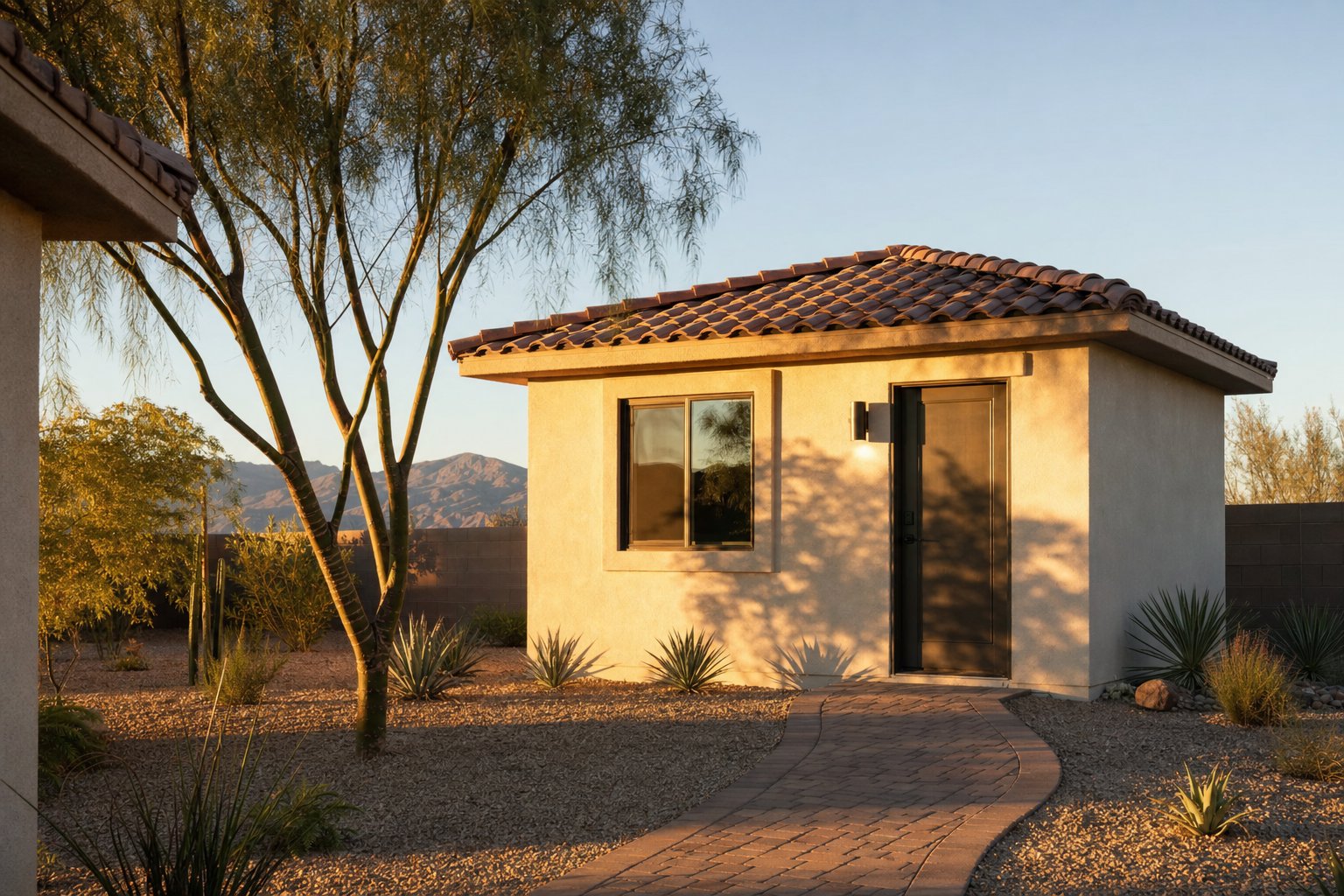
The short version
- Official term in unincorporated Clark County
- Accessory Living Quarters, not "ADU" — a keyword search of Title 30 effective 07/23/2026 returns no occurrences of "accessory dwelling unit"
- Maximum number per lot
- One, in Clark County, the City of Las Vegas and Henderson (Title 30, City UDC, Henderson code)
- Clark County lot-size floor
- Not allowed on a lot under 4,000 sq ft, a standard that "shall not be waived or varied" (Title 30 §30.03.03)
- Size cap
- County: 75% of the primary dwelling on lots under 10,000 sq ft. City of Las Vegas: 100% of primary gross floor area per Ord. 6963. Henderson: 25% or 1,000 sq ft, whichever is greater
- Controlling state law
- NRS 278.257, added by AB 396 (2025), effective July 1, 2026 (AB 396)
- License that cannot build one
- B-7 Residential Remodeling — it "may not increase existing enclosed space" (NAC 624.170)
What each jurisdiction allows
The valley is five separate rulebooks. The address decides which one applies to you — not the mailing city on your envelope.
| Jurisdiction | Allowed? | Key limits | Approval path | Source |
|---|---|---|---|---|
| Unincorporated Clark County | Yes, as an accessory use in RS80, RS40, RS20, RS10, RS5.2, RS3.3, RS2, RM18, CR, AG, OS and PF. Not allowed in RM32, RM50 or any commercial or industrial district. | One per lot. No lot under 4,000 sq ft. Under a 10,000 sq ft lot, no more than 75% of the primary dwelling’s habitable gross floor area; at 10,000 sq ft or larger, or in the Nonurban Area, up to the full primary gross floor area. Similar roof line and complementary colors and materials. No RVs. One parking space. | Accessory use — approved with the building permit, in conjunction with a single-family residence. No hearing. | Title 30 §30.03.03 and Table 30.02-2 |
| City of Las Vegas | Yes, as a conditional use in U, R-E, R-D, R-1, R-SL, R-CL, R-TH, R-2, R-3, R-4 and R-MH, added by Ordinance 6963 effective 07/01/2026. | One per lot. Subject to the underlying district standards but "in no case shall the unit exceed the total gross floor area of the primary dwelling unit." One additional parking space beyond what the district already requires. See the conflict flagged below: district accessory tables still say 50%. | Conditional use under LVMC 19.12.070. The ADU entry states expressly that "the Special Use Permit provisions of LVMC 19.12.040(B) do not apply to this use" — no SUP hearing. | City of Las Vegas UDC, Ord. 6963 |
| Henderson | Yes, as an S use — special use permit — in RS, RM, RH, MC and MN. Blank, meaning not allowed, in RMH, MR, CN, CO, CC, CH, CT, CA, IL, IG, IP, DH, PS and DP. | No more than 25% of the principal dwelling’s floor area or 1,000 sq ft, whichever is greater. A tiny house is capped at 400 sq ft excluding lofts. One per lot. Detached units 14 ft or less in height take 5 ft side and rear setbacks; taller units must meet the principal dwelling’s setbacks. 6 ft separation from other buildings. One parking space. May not be sold apart from the principal dwelling. | Special Use Permit, per the code codified 12/20/2024. See the conflict flagged below. | Henderson Development Code §19.9.4.B.6 |
| North Las Vegas | Not published — n.a. | Not published — n.a. | Not published — n.a. The NLV municipal code text could not be retrieved from a primary source, so we will not characterize its ADU rules. Call the permit center at (702) 633-1536. | NLV Permit Application Center |
The word you use decides which rulebook you get
Ask for an "ADU" in unincorporated Clark County and you may get a blank look, because the County does not use the term. Title 30 calls it Accessory Living Quarters: "a subordinate dwelling unit designed for one family, used for residential purposes… including rental for occupancy by others, in a portion of the primary dwelling without interior access, or a separate structure located on the same lot as the primary dwelling." An ALQ "shall not be considered an additional dwelling unit when calculating density" (Title 30, defined terms). A search of the full Title 30 text effective 07/23/2026 turns up no occurrence of the phrase "accessory dwelling unit."
The County’s own single-family permit guide adds a third word, guest house, and attaches a consequence to it: "secondary habitable structures, guest houses, or any detached accessory structures require their own source of water," and "secondary detached structures containing plumbing require their own sanitation verification" (BPG-182).
Accessory building is not the same thing
Title 30 separately defines an Accessory Building as having "no interior access to the primary building" and one that "shall not be used as a dwelling" — garage, workshop, shed, game room, pool house, cabana (Title 30). The City of Las Vegas draws the same line more bluntly: a Residential Accessory Structure "may contain any type of room use but may not contain any kitchen," except as specifically provided for ADUs (LVMC 19.06.040(C)).
In the City, the kitchen is the legal dividing line. Kitchen means ADU and the ADU rules apply. No kitchen means accessory structure. And "kitchen facilities" is defined at the state level to include, "without limitation, a sink, refrigerator and a significant cooking appliance such as a range, stove or oven" (NRS 278.257). A wet bar with a hot plate is a conversation you will have with a plans examiner.
Henderson uses all three words in its code. It defines an ADU as a building or structure, "including a tiny house," on the same lot as a principal dwelling and "intended for occupancy as separate living quarters"; a Casita as "a small house, apartment, or similar structure used as an accessory dwelling or guest house"; and a Carriage House as an ADU with "permanent habitable space above a garage" (Henderson Development Code).
What state law now guarantees you, and what it does not
AB 396 (2025) was approved June 6, 2025 as Chapter 365, and its ADU provisions took effect July 1, 2026, codified at NRS 278.257 (AB 396 enrolled text; NRS 278.257). It applies to counties of 100,000 or more and cities of 60,000 or more, which in Southern Nevada means Clark County, Las Vegas, Henderson and North Las Vegas. Those governments "shall adopt an ordinance that authorizes the development and use of an accessory dwelling unit on residential property."
The statute then lists things a local ordinance may not do as a condition of approval. It may not prohibit separate kitchen facilities. It may not require more than one additional parking space, and none at all if existing plus street parking already meets the anticipated need. It may not impose side or rear setbacks more restrictive than those for the primary residence. It may not require public street improvement or repair, except to repair a street actually disturbed during construction or for public health and safety. And it may not prohibit the owner from using the unit as rental housing. It may prohibit use as transient lodging (NRS 278.257(2)).
Two more provisions matter on the construction side. An approved ADU must meet residential building, housing and safety codes, and is not required to meet commercial codes, "including, without limitation, any code that requires a fire sprinkler system in a commercial building" (NRS 278.257(3)). And nothing in the section authorizes more than two ADUs on a residential property, or stops a local government from being more generous — including "providing for the approval of the construction of an additional dwelling unit by building permit in lieu of approval by the planning department" (NRS 278.257(4)).
What is not in the statute
There is no statewide size cap, no statewide minimum lot size, and no owner-occupancy requirement in NRS 278.257. Local caps like the County’s 75% and Henderson’s 25% are local, not state. And nothing we located in AB 396 overrides private CC&Rs that prohibit ADUs — the bill amended common-interest community law in several places (NRS 116.2117, 116.2118, 116.4109 and the fine ceiling in 116.785) without touching a covenant ban (AB 396).
Clark County is explicit about staying out of it. Title 30 §30.01.04(F)(4) says the County does not intend to interfere with private covenants and "is not responsible for monitoring or enforcing private agreements or restrictions" (Title 30). A permit does not defeat an HOA restriction.
Two live conflicts you should know about before you draw anything
As of the August 30, 2026 research date behind this page, two of the local rule sets do not line up. We are not going to paper over that, because in both cases the reader is the one who eats the delay.
The Ordinance 6963 conditional-use text says an ADU may go up to the total gross floor area of the primary dwelling — 100%. But the district accessory-structure tables in the same codified UDC (U, R-E, R-D and the R-1/R-2/R-3 Table 2) cap accessory size at "not to exceed 50% of the floor area of the principal dwelling unit," and the U, R-E and R-D footnotes say so specifically for a Residential, Accessory Dwelling Unit. Both appear in the same document (City of Las Vegas UDC). Get the governing figure for your specific lot in writing from City planning before an architect sizes the unit.
Henderson’s codified ADU standard, effective 12/20/2024, routes ADUs through a discretionary Special Use Permit and caps them at 25% of the house or 1,000 sq ft (Henderson Development Code). AB 396 §11(2) provides that if a covered city or county "does not adopt an ordinance that is consistent with the provisions of section 1 of this act before July 1, 2026, accessory dwelling units are authorized on any parcel zoned for residential use without restriction" (AB 396). Henderson’s published Development Code Revisions log lists no ADU or AB 396 ordinance (Henderson revision log), and no Henderson conformance ordinance was located.
We are not telling you Henderson ADUs are unrestricted. We are telling you the codified rule and the statute point in opposite directions, that no conformance ordinance has surfaced, and that you should ask Henderson planning in writing which one controls your parcel before you spend money on drawings.
For contrast, the City of Las Vegas did conform. Ordinance 6963, effective 07/01/2026, added Residential, Accessory Dwelling Unit to the Table 2 use matrix as a conditional use in eleven districts, added the LVMC 19.12.070 conditional-use regulations, and expressly switched off the Special Use Permit requirement (City of Las Vegas UDC). That is the City’s AB 396 conformance ordinance.
Permits, utilities and the fire-flow trap
You need a building permit plus separate sub-permits for electrical, plumbing and mechanical. Clark County wants a completed Sub-Permit Application (form BPA-010) for each, filed either with the building package or after building approval (BPG-182; Clark County application forms). A permit is required to "construct, enlarge, alter, repair, move, demolish a building or change occupancy" and to install or alter electrical, gas, mechanical or plumbing systems (Do I Need a Permit).
The exemption people ask about does not help here. Clark County exempts one-story detached accessory buildings used as tool sheds, playhouses "and similar non-occupiable space" only if floor area stays under 200 square feet and no electrical, mechanical or plumbing is installed (Clark County Code §22.02.190). A habitable casita never qualifies.
Your casita usually needs its own water and sewer
Before a permit issues, the County wants water verification — an LVVWD commitment, another purveyor, or a well permit — and sanitation verification, either a CCWRD connection fee receipt or a Southern Nevada Health District septic permit. And detached habitable structures "require their own source of water," with detached structures containing plumbing requiring their own sanitation verification (BPG-182). Budget for it: the SNWA regional connection charge "applies whether a connection is the result of new development or modifications to property within existing development, including the connection of additional dwelling units" (LVVWD Service Rules).
The fire-flow threshold nobody sees coming
Clark County requires an automatic sprinkler system throughout a dwelling "when the total fire area exceeds 10,000 square feet or whenever there is insufficient fire department access or insufficient fire flow at the fire hydrants." Separately, when the total area of each floor under roof — including all attached accessory structures — exceeds 3,600 square feet, the building must have minimum required fire flow available at the hydrants or it gets sprinklered (BPG-182).
That is a per-project arithmetic problem, not a philosophy question: a 3,200 sq ft house plus a 600 sq ft attached casita crosses the line. Note also how this interacts with state law — NRS 278.257(3) exempts an ADU from commercial sprinkler codes, not from residential ones (NRS 278.257).
Grading and dust
Land may not be cleared, rough-graded or stockpiled before a grading permit issues, and a Dust Control Permit from the Department of Environment and Sustainability is required if grading or soil-disturbing activity exceeds a quarter acre or trenching exceeds 100 feet (Title 30 §30.06.11E). An MSHCP land disturbance form must be completed for all grading, building and offsite permits before issuance (Title 30).
One more form we cannot characterize: the County lists an "Accessory Apartment Deed Restriction" in its application inventory, but the form’s contents were not retrieved, so its trigger conditions are unknown (Application Forms). Ask whether it applies to you rather than assuming either way.
How long review takes, by jurisdiction
Clark County publishes first-review goals and holds itself to them in public. Residential Minor — residential work that is neither a standard plan nor a custom home — carries a 14-day goal. A Custom Single Family Residence is 21 days. Revisions and all subsequent or correction reviews are 10 days (Plan Review Timelines).
The mechanics: initial review, then a plan correction letter, then corrections uploaded through the Citizen Access Portal, then a fee work-up once every discipline shows complete. Revisions to an issued permit go in on the Hourly Plan Review Application (Form 1017) with delta and cloud markups (Plan Review Process). Because reviews run concurrently, the County warns you "could receive more than one plan correction letter on multiple issues pertaining to zoning, architectural, structural, plumbing, mechanical and/or electrical issues" (BPG-182). Each one restarts a 10-day clock, which is how a 21-day goal becomes a season.
Inspections are scheduled by portal, phone, video or text. Saturday inspections run 7 a.m. to 4 p.m. for listed residential scopes if you request by 2 p.m. Friday; the scheduling line is (702) 455-8040, and the job card and approved plans must be on site (Schedule an Inspection). Watch the clock after issuance: an approved required inspection must be obtained within 180 days of issue or of the last approved inspection, or the permit is null and void — 365 days at Mt. Charleston (BPG-182).
The City of Las Vegas publishes no standard residential plan review turnaround on its permit pages. It sells speed instead: owner/builder express review at a $550 non-refundable administrative fee plus $660 per hour above published plan review fees, with pre-review appointments starting at $176 per hour (Building & Offsite Permits). Electronic submittal is mandatory.
Henderson prices expedited review at four times the normal plan review fee — half at submittal, the rest at issuance, and the remainder waived if the City misses its target — for 4 full working days on building permits and on Public Works civil, traffic and hydrology reviews, initial and subsequent, with working days counted Monday through Thursday. H-1 through H-5 hazardous occupancies are excluded (Henderson Expedited Review).
North Las Vegas turnaround times are not published on either the Building Safety or the Permit Application Center page (NLV Building Safety). We will not invent one.
If you plan to rent it out
State law is on your side on the zoning question and against you on the licensing question, and people miss the second half.
On zoning: a local ordinance may not prohibit an owner from using an ADU as rental housing, though it may prohibit transient lodging (NRS 278.257(2)). Clark County’s ALQ definition itself expressly includes "rental for occupancy by others," and Henderson’s code says an ADU "shall not be sold apart from the principal dwelling upon the same lot" — sold, not rented (Title 30; Henderson Development Code).
On licensing: NRS 624.031 exempts from contractor licensure an owner "building or improving a residential structure on the property for his or her own occupancy and not intended for sale or lease." Offering the structure for sale or lease within 1 year of completion creates a rebuttable presumption that it was built for sale or lease, and the owner has to apply to the Board for the exemption in the first place (NRS 624.031). Clark County requires an Owner Builder Affidavit of Exemption and ownership shown in Assessor records (Licensing Requirements).
So the owner-builder path and the rental plan are in tension by design. If the casita is an income unit, hire a licensed contractor and keep the exemption out of it.
The license classification this work requires
A casita is residential construction of a structure not more than three stories above ground, which puts it in NSCB B-2 "Residential and Small Commercial." That classification covers "construction and remodeling of houses and other structures which support, shelter or enclose persons or animals or other chattels, and which do not extend more than three stories above the ground and one story below the ground" (NAC 624.170). An unlimited B General Building license also covers it.
The classification that cannot do this job
B-7 Residential Remodeling applies to remodeling an existing detached single-family residence of three stories or fewer, but it "may not increase existing enclosed space" (NAC 624.170). A new casita is new enclosed space. A B-7 licensee cannot build your casita. A B-7 can convert and remodel within the existing envelope; the moment walls go up around new floor area, you need B-2 or B.
Note also what a general building license does not include. A general building contractor "shall not perform specialty contracting in plumbing, electrical, refrigeration and air-conditioning or fire protection without a license for the specialty" (NRS 624.215). Expect separately licensed C-1 plumbing and heating, C-2 electrical and C-21 refrigeration and air conditioning subcontractors, plus C-1b fire protection sprinklers or C-41 fire protection if you cross the sprinkler threshold (NSCB classifications).
How the monetary limit works
Every Nevada license carries a dollar limit, and the limit is not per contract. NRS 624.220 requires the Board to set a monetary limit that is the maximum contract a licensed contractor may undertake on one or more construction contracts on a single construction site or subdivision site for a single client (NRS 624). Read that carefully: it aggregates. Splitting one job into three contracts does not get a contractor under the limit, because all three are the same site and the same client. The Board can raise the limit for a single project on request, and where a contractor is bidding work above the limit, the increase has to be requested at least 5 working days before the bid opening and approved before the bid goes in (NRS 624.220). The Board may also count trades that are incidental and supplemental to the classification, and may condition a license in other ways.
Nobody at the permit counter is going to catch this for you. Clark County verifies that the license is active and that a Multi-Jurisdictional Business License and a matching DBA exist (Clark County licensing requirements). Whether the classification and the limit actually fit your job is your check to make, on the Board lookup, before you sign.
Clark County adds its own layer on top of the state license: an active NSCB license plus an active Multi-Jurisdictional Business License covering Clark County, Las Vegas, Henderson and North Las Vegas, a DBA that matches, and a Citizen Access Portal account linked to the license (Licensing Requirements).
Published fees
These are government fee schedules, not a cost estimate for your project. Building Las Vegas is a media company — we do not bid, quote, or price work.
| Fee | Published amount | Charged by | Source |
|---|---|---|---|
| Clark County building permit fee | Valuation-based. The County determines "an estimated valuation of work… based upon the square footage of the residence" and calculates the permit fee from that valuation. The dollar table itself is not published in retrievable form — use the County estimator and treat it as an estimate. | Clark County Building & Fire Prevention | BPG-182 · fee calculator |
| Clark County plan review fee | 65% of the building permit fee, payable at submittal | Clark County Building & Fire Prevention | BPG-182 · Fees/Calculator |
| MSHCP development disturbance fee | $550 per acre, one time, collected at the grading or building permit | Clark County Desert Conservation Program | Development Disturbance Fee |
| Clark County transportation privilege tax | $1,000 per single-family dwelling unit on or after July 1, 2020. Exceptions include "rehabilitation, remodeling, or expansion of an existing single-family dwelling unit" — ask whether your casita is read as an expansion or a new unit. | Clark County (Title 4.22) | CCC §4.22.020 · §4.22.030 |
| CCWRD sewer connection fee | $3,020 per ERU (effective July 1, 2022, 2023 and 2024, adjusted annually by the lesser of CPI or the equity-based formula). Septic conversion $1,600. | Clark County Water Reclamation District | CCWRD Services |
| CCWRD annual sewer service charge | $307.16 per ERU effective July 1, 2026, rising to $319.44 in 2027 and $333.84 in 2028, plus $4 per bill issued | Clark County Water Reclamation District | CCWRD Services |
| LVVWD application fee, new service | 5/8-inch meter $140; 3/4-inch $210; 1-inch $350; 2-inch $1,120 | Las Vegas Valley Water District | LVVWD Service Rules, App. I Table A.3.a |
| LVVWD facilities connection charge | 5/8-inch $2,371; 3/4-inch $3,556; 1-inch $5,927; 1.5-inch $11,854; 2-inch $18,967 (effective 3/1/2026, adjusted each March 1 by ENR CCI 20-City) | Las Vegas Valley Water District | LVVWD Service Rules, Table A.3.b |
| SNWA regional connection charge, residential | 5/8-inch and 3/4-inch $7,998; 1-inch $15,780; 1.5-inch $31,476; 2-inch $50,377 (effective 3/1/2026). Applies expressly to "the connection of additional dwelling units." | Southern Nevada Water Authority, billed through LVVWD | LVVWD Service Rules ch. 7.22 and Table A.18.a |
| City of Las Vegas addition fee reference | Table 3-A, R-3 Single-Family Residential – Addition: 200 sq ft $168 plan check / $361 inspection; 500 sq ft $308/$641; 1,000 sq ft $467/$938; 2,000 sq ft $797/$1,359. These are 2020 Building User Fees with Table 3-A effective July 1, 2021 — current amounts may differ. | City of Las Vegas Building & Safety | City of Las Vegas fee tables |
| City of Las Vegas owner/builder express review | $550 non-refundable administrative fee plus $660 per hour above published plan review fees; pre-review appointments from $176 per hour | City of Las Vegas Building & Safety | Building & Offsite Permits |
| Henderson permit and plan review fees | n.a. — the schedule took effect October 1, 2025 and is "reviewed annually and adjusted using a regional Consumer Price Index," but the individual amounts are in script-loaded PDFs that could not be retrieved. Expedited review is 4x the normal plan review fee. | City of Henderson Development Services Center | Henderson Fees Schedules · Expedited Review |
| North Las Vegas | Administrative fee $75 per permit; park impact fee $0.36 per sq ft residential; recording fee 3% of permit fee, $2 minimum; plan check 65% of permit fee; planning and zoning review 10%; fire review $100; re-inspection $100; plus the Clark County transportation tax of $1,000 per residential unit | City of North Las Vegas | NLV Permit Application Center |
| Clark County residential construction (park) tax | n.a. — governed by Clark County Code Title 19.05, whose text was not retrievable. The state cap is not more than 1% of building permit valuation or $1,000 per residential dwelling unit, whichever is less. | Clark County, at fee work-up | Fees/Calculator · NRS 278.4983 |
| State Water Impact Fee | n.a. — required by the Nevada Division of Water Resources under NRS 540.61 to 540.091; no amount is published by the County | Nevada Division of Water Resources | Fees/Calculator |
| School construction impact fee | None found. No Nevada or CCSD school construction impact fee appeared in any published fee schedule for Clark County, Las Vegas, Henderson or North Las Vegas. Treat as apparently none rather than assuming an amount. | n.a. | Clark County Fees/Calculator · City of Las Vegas fee tables |
Why these projects get rejected or stall
- Lot too small or unit too large. Clark County’s 4,000 sq ft minimum lot and the 75%-of-primary cap under 10,000 sq ft both "shall not be waived or varied," so there is no variance to ask for (Title 30).
- A second unit on the lot. One per lot in Clark County, the City of Las Vegas and Henderson — even though state law tolerates up to two per property, the local caps are what your permit is read against (Title 30; City UDC; Henderson code).
- No independent water or sewer verification for a detached unit containing plumbing (BPG-182).
- Fire-flow trigger crossed once the casita’s roof area is added to the house’s and the combined floor under roof passes 3,600 sq ft (BPG-182).
- Multiple simultaneous correction letters across zoning, structural and MPE disciplines, each restarting a 10-day review clock (Plan Review Timelines; BPG-182).
- Contractor licensing mismatch — an inactive NSCB license, a missing Multi-Jurisdictional Business License, or a DBA that does not match blocks issuance outright (Licensing Requirements).
- Permit lapse at 180 days with no approved inspection since issue or since the last approval (BPG-182).
- The 2026 jurisdictional conflicts — the City’s two size caps in one codified document, and Henderson’s SUP requirement sitting against NRS 278.257 (City UDC; AB 396).
Verify before you start
- Which jurisdiction the parcel is actually in — unincorporated County, City of Las Vegas, Henderson or North Las Vegas. The terminology, the districts and the caps all differ, and nothing transfers.
- Your zoning district and lot size measured against the applicable cap: the 4,000 sq ft floor and 75%/100% ratio in the County, the unresolved 50% versus 100% question in the City, 25%-or-1,000 sq ft in Henderson.
- Whether the property is subject to CC&Rs. The County expressly does not enforce private covenants, and a permit does not override them.
- Whether a separate water meter and sewer connection are feasible, and the SNWA regional connection charge that applies to additional dwelling units.
- Combined floor area under roof against the 3,600 sq ft fire-flow trigger and the 10,000 sq ft sprinkler threshold.
- Whether you intend to rent. State law protects rental use but permits a local transient-lodging ban, and the NRS 624.031 owner-builder exemption is undone by intent to lease within a year.
- Your contractor's NSCB classification and monetary limit against the contract amount — and confirmation that it is not a B-7, which cannot add enclosed space.
- Which code edition governs at your application date, given the January 2026 adoptions in both the County and the City.
Here is what we could not confirm from a primary source, stated plainly rather than filled in.
North Las Vegas has no ADU rules on this page because we could not retrieve them. The NLV Title 17 zoning text was unavailable from primary sources, so the ADU definition, permitted districts, size limits and approval path are all n.a. Start at the NLV Permit Application Center and call (702) 633-1536.
Henderson’s fee amounts are unknown. The schedule took effect October 1, 2025 with annual CPI adjustment, but the fee PDFs are script-loaded and were not retrievable, so we publish no Henderson dollar figures (Henderson Fees Schedules). Henderson’s adopted code editions were also n.a. from the page we fetched (Henderson construction codes). And no Henderson AB 396 conformance ordinance was located — the absence is the finding, not proof that none exists.
Clark County permit fee dollar amounts are not published in retrievable form. The Title 22.02 fee listing at §22.02.385 was not retrievable, and the County directs users to a calculator that produces estimates only (fee calculator). The residential construction (park) tax amount under Title 19.05 is likewise n.a.; only the NRS 278.4983 statutory cap is known. The State Water Impact Fee amount is n.a. — only the statute and the agency are published.
The County’s "Accessory Apartment Deed Restriction" form appears in the application inventory, but its contents were not retrieved, so we cannot tell you when it is triggered (Application Forms).
BPG-182, which this page relies on for process, carries a document date of 2/17/2017 and still references the UBC and pre-2024 prescriptive values. Use it for process and clearance sequence; verify every numeric code value against the January 2026 code adoptions (Clark County Building Codes). The City of Las Vegas fee PDF is titled "2020 Building User Fees" with Table 3-A effective July 1, 2021, so treat those figures as 2021-effective.
AB 131 (2025), relating to accessory dwelling units on historic properties, was identified but its text was not fetched, so its content is n.a. (AB 131 bill page). If your house is historic, read it yourself before relying on anything on this page.
Finally, no school construction impact fee appeared in any fetched fee schedule for any of the four jurisdictions. We report that as "none found," not as "none exists."
Sources
- Clark County Title 30 Unified Development Code, effective 07/23/2026
- City of Las Vegas Unified Development Code (Title 19)
- Henderson Development Code, effective 12/20/2024
- NRS 278.257 and NRS 278.253 (Chapter 278)
- AB 396 (2025) enrolled text
- NRS Chapter 624 — Contractors
- NAC Chapter 624 — license classifications
- Nevada State Contractors Board — license classifications
- Clark County BPG-182, Single Family Residence & Guest House Building Permit Guide
- Clark County Plan Review Timelines
- Clark County MSHCP development disturbance fee
- CCWRD connection and service charges
- LVVWD Service Rules, adopted January 1, 2026
- City of Las Vegas Building & Offsite Permits
- North Las Vegas Permit Application Center
Planning a project of your own?
We cover this market for a living, which means we know what things actually cost right now, who is busy, and who is good. Tell us what you're planning and we'll point you toward independent licensed contractors who specialize in it — no cost, no obligation.
Tell us about your projectBuilding Las Vegas is a media company, not a contractor.
The Friday Pipeline
Everything that changed in the valley this week, in one email.
Status changes on every tracked project, the permits and agenda items nobody else flagged, and one chart. Free, once a week, no fluff.